Stafford shop
Tech did very good job on alignment on my Mercedes
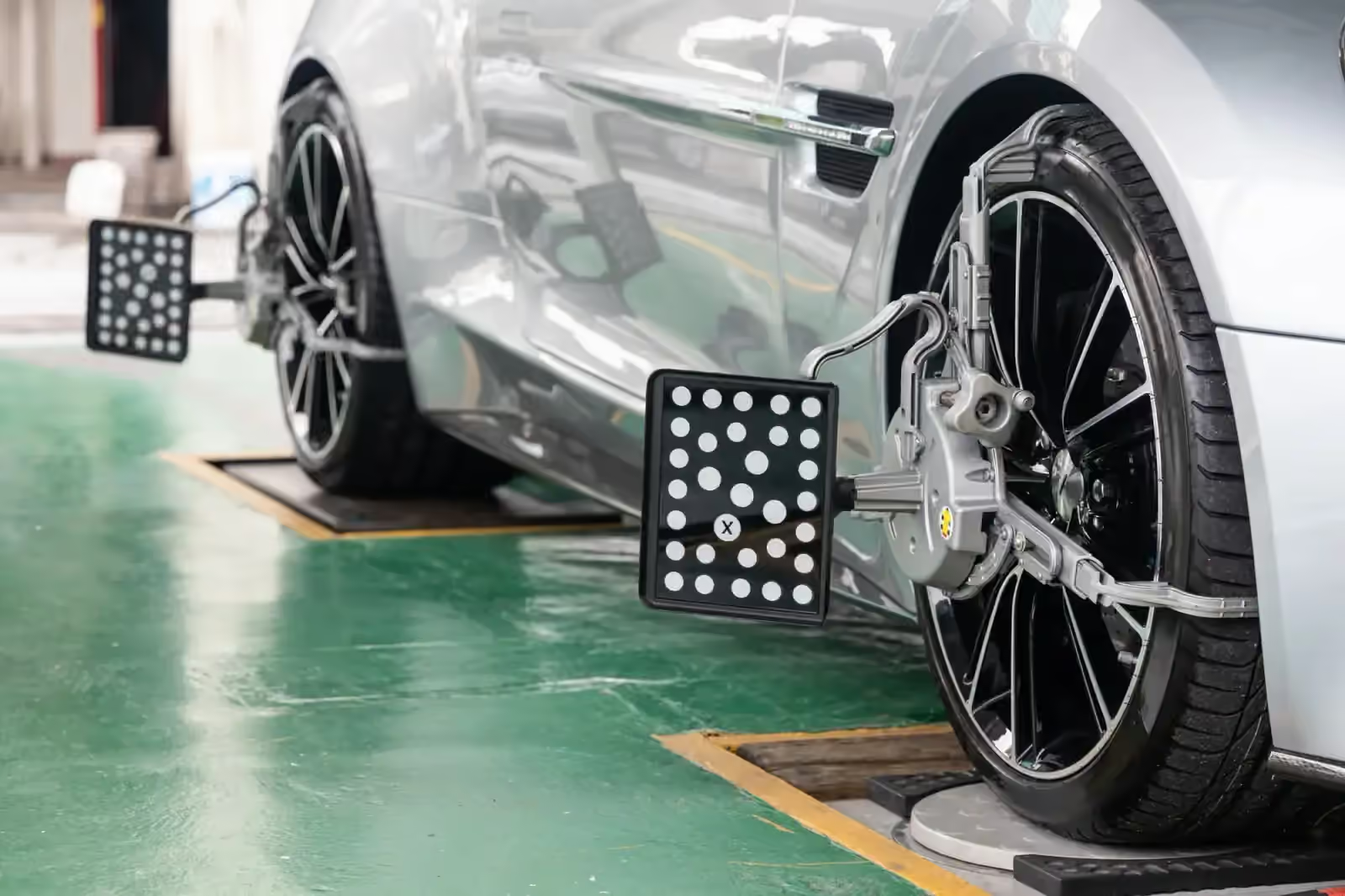
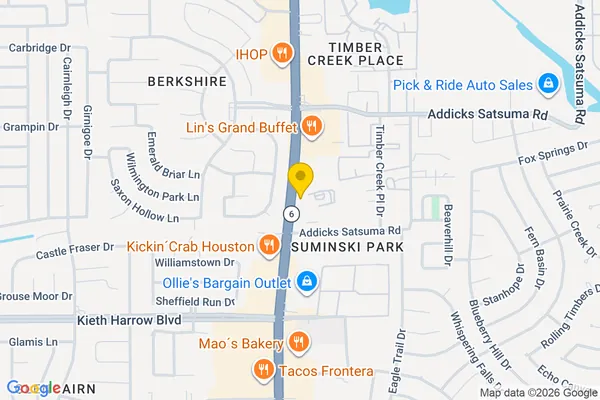
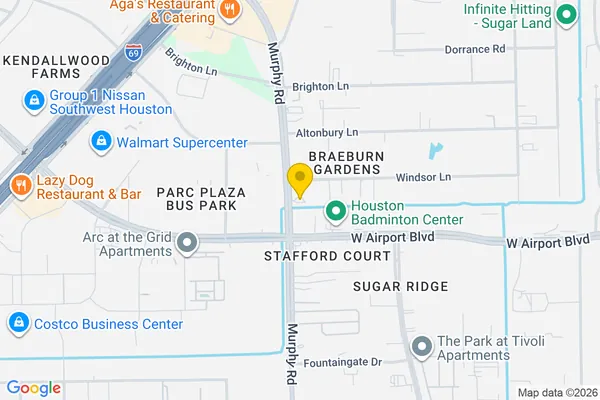
We measure and correct wheel alignment at our two shops, at 5118 Hwy 6 N, Houston, TX 77084, and at 12319 Murphy Rd, Stafford, TX 77477.
We set your steering and suspension angles so your car or truck tracks straight and your tires wear evenly.
Updated

We measure and correct the wheel angles on your car or truck when it pulls to one side, has a crooked steering wheel or wears down one edge of its tires. Our two shops have handled more than 18,000 alignment visits combined, at Stafford since 2000 and at Houston since December 2023.
An alignment covers three angles. Camber is how far the top of the tire tilts in or out when you look at it from the front. When camber is off, one edge of the tread carries most of the weight and wears out first. Caster is the forward or backward tilt of the steering axis, and the right caster helps the steering wheel come back to center after a turn. Toe is whether the front edges of the tires point in or out. When toe is off, the tread scrubs sideways across the pavement as the wheel rolls.
The makes we see most for wheel alignments are Chevrolet, GMC and Ford. One of them came in October 2026, when we did a wheel alignment on a 2007 Chevrolet Silverado. If your pickup's front tires are wearing faster on the edges than in the middle, have that pattern measured, because uneven edge wear is one way camber and toe problems show up on the tread.
If your car or truck drifts left or right on a level road and you have to hold steady pressure on the wheel to go straight, that's a pull. A crooked steering wheel often comes with it: the spokes sit off center while the tires roll straight ahead. Both happen when the wheel angles on one axle don't match, so one tire tracks true and the other drags a little to the side.
A pull or a crooked wheel can have more than one cause, so neither one proves an alignment problem by itself. Your tires often give a second clue at the edges of the tread:
Worn steering parts can cause the same wear. A loose ball joint or a bent tie rod lets the wheel shift while you drive, and no alignment setting holds on a loose joint.
Uneven wear is the reason to book soon. A tire scrubbing at the wrong angle loses tread fast on one edge. Once that edge wears down to the steel belts under the rubber, the tire has to be replaced, and an angle adjustment becomes an alignment plus new tires.
Broken pavement and rough lane edges hit the steering and suspension hard, and hard hits are what knock wheel angles out of spec.
Adjusting the angles won't straighten a bent part. We replace damaged parts through suspension and steering repair, and the alignment gets set once the new parts are in.
A wheel alignment brings camber, caster and toe back to factory specs by adjusting the steering links and suspension mounts at each axle.
New angles only stay put on tight parts. If a tie rod end or bushing has play in it, the wheel moves around the new setting and the alignment drifts again.
We look over the steering and suspension before we set your wheel angles, because a loose joint lets a fresh alignment shift on the first bump.
Four things move the total: how many wheels adjust, the shape the adjustment hardware is in, whether your suspension needs extra parts to reach spec and whether a steering sensor needs a reset.
Worn steering or suspension parts found ahead of the alignment are a separate repair with their own parts and labor.
Before we set camber, caster and toe, we look over the tires, tie rods, ball joints and control arms that have to hold those angles, and we finish with your steering wheel centered. Our Houston shop has 4.6 stars from more than 400 Google reviews. Our Stafford shop has 4.5 stars from more than 500 Google reviews. Stafford alignment customers have left 13 reviews, averaging 4.3 stars.
Tech did very good job on alignment on my Mercedes
Great service came in for an alignment on my Lincoln, after I bought new tires. Told him there was a vibration. After they took it on a test drive, they found out that my rear hub assembly was bad and needed replacing, As well as my real brakes needed to be done.
We do wheel alignments at our two shops in Houston and Stafford. Our Houston shop is on Hwy 6 N, and our Stafford shop is on Murphy Rd. Bring your car or truck to whichever one is easier for you to reach.
Either one, since both do wheel alignments: our shop on Hwy 6 N in Houston or our shop on Murphy Rd in Stafford. Pick the one closer to you.
A wheel that's out of balance usually causes a vibration you feel at highway speed. An alignment problem shows up as a pull to one side on a flat road, or a steering wheel that sits off center while you drive straight. Wear on one edge of the tread also points toward the angles. Several problems can cause these signs, so have the car checked to find out which one it is.
It can. A hard hit from a deep pothole can bend a tie rod or let an adjustment bolt slip, and then the wheel no longer points where it should. The tire scrubs against the road and wears down on one edge. If your car starts pulling or the steering wheel goes crooked after a hard hit, have the angles measured.
It's a good time to have the angles checked. If your old tires wore down on one edge, the angles behind that wear are still there. New tires on the same angles start wearing the same way. Setting camber, caster and toe keeps the new tread flat on the road.
It depends on your suspension design and the condition of the hardware. A vehicle that adjusts only at the front takes less time than one that adjusts at all four wheels. Rusted bolts that fight being turned add time. If a worn part like a ball joint turns up first, that repair comes before the angles are set.
Our Houston shop's number is (281) 463-8079. Our Stafford shop's number is (281) 879-0843. Call us, or send us a message.